With God's help Date: 28.6.2012
Chapter 1: The Origins and Youth of Great-Grandpa David Mendelson, of Blessed Memory
Country of origin: Russia
Hometown: Dvin
Date of birth: January 1, 1915
His mother's name: Hannah Mendelson, of blessed memory
His father's name: Abraham Mendelson, of blessed memory
His brothers' names: Leib Aryeh Mendelson, of blessed memory, Eliyahu Mendelson, of blessed memory
Great-Grandpa David Mendelson, of blessed memory, was born on January 1, 1915, a year after the start of World War I. Widespread destruction, Jews fighting on both sides of the barricades. The German Jews were German patriots, and the Russian Jews defended Russia. For the first time in history, the Germans used poison gas. Masses of dead, hundreds of thousands wounded, and the Jews, as usual, caught between a rock and a hard place. The Jews in Germany were accused of treason; in Russia, the local Jews were called German spies whose language, Yiddish, resembled German.
My grandfather heard from Great-Grandpa David, of blessed memory, about an incident during the war when a Russian soldier and a German soldier encountered each other in a trench during battle. The Russian soldier pushes the German against the wall of the trench; they are so close together that neither can fire. All they can do is grapple with each other. The Russian proves stronger or quicker and strikes the German on the head with his rifle butt. The German falls to his knees, clutching his rifle, and the Russian aims his bayonet at his enemy's throat. With surprising boldness, the German uses his rifle to knock aside the bayonet aimed at him, and now his own bayonet is pointed at the Russian soldier's heart. Now they will kill each other.
"Hear, O Israel"- the Russian cried out, covering his eyes with his hand.
Something inexplicable happens—his voice echoes through the narrow trench in two voices. He opens his eyes, thinking he has reached the next world, and before him is the German, his eyes shut, also crying out, "Hear, O Israel." They are both Jews. They embraced and began to cry...
Little David and his family were tossed about across Europe: Vienna, Dvinsk, and then Belarus. He spent his childhood in Minsk. His father was a shoemaker, his mother visually impaired, and her entire day was taken up with finding food for her family.
He was master of his own fate, with no one to watch over him, and the only influence on him was the postwar street.
Once, a gang of thugs caught him and forced him to smoke cigarettes. He nearly choked, but they "encouraged" him to keep going—"Breathe in deep, little Jew!" His head spun, a black, smoke-filled veil covered his eyes, but they would not let up—"Smoke! You snake." Nausea set in, followed immediately by a torrent of vomiting. They forced him to smoke 2.5 cigarettes, and he apparently lost consciousness. Kindhearted people found him and brought him home. His poor mother wept bitterly—"My Dudik, Dudik, what have they done to you?" That same gang continued forcing him to smoke, and later smoking became a symbol of maturity and independence. A bad, harmful habit, and so he smoked all his life until he developed a stomach ulcer and cirrhosis of the liver. By then, he could no longer smoke.
During the war against the Germans, he often traded his daily bread ration for cheap tobacco scraps. My grandfather remembers him always having a cigarette in his mouth. As a teenager, my grandfather would secretly take cigarettes from him and try smoking in the bathroom, out of everyone's sight. Great-Grandpa David apparently noticed, but he did not hide the cigarettes; he simply told my grandfather how he had started smoking...
Chapter 2 :Great-Grandpa David Mendelson's Adult Life
Unfortunately, I do not know the details of Great-Grandpa David's studies, how he completed them, or why, as a young specialist, he came from the capital city of Minsk to Rechitsa. Despite the many times my grandfather asked his mother about their first meeting, he never got an answer—"It was all very simple.." was her reply.
I do not know exactly how or who sent him, but at some point Great-Grandpa David arrived in Kazan for a signals officers' course. This was prewar Kazan, and Great-Grandma Miriam followed him there, pregnant for the first time—with my grandfather. Great-Grandpa David was an expert in everything to do with radio and, later, television, and he passed his "golden hands" on to his children and grandchildren. He was a genius who taught himself everything he knew, and then taught my grandfather too. Photography, developing pictures, bicycles, motorcycles, cars, and weapons—everything came to life beneath his hands.
When my grandfather was nine, he taught him to ride a bicycle. He ran after him for almost an entire day—and thanks to that, my grandfather mastered it.
Great-Grandpa David, of blessed memory, never abandoned anyone in trouble, especially not a Jew in need. He always came to help with a kind word, good advice, and money. It seems that this trait came down to us from him and Great-Grandma Miriam.
Chapter 3 : His Service in the Red Army
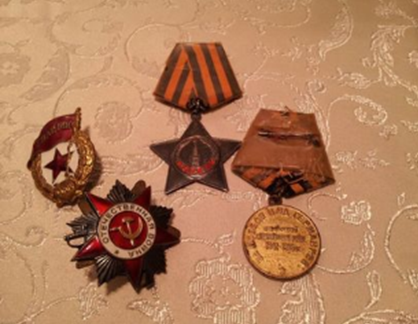
Great-Grandpa David Mendelson, of blessed memory, who served in the Red Army, told my grandfather that he once performed a deed for which he deserved the highest decoration for bravery in Soviet Russia. However, because of certain circumstances, he did not receive "the Gold," but rather the Red Star.
Since Great-Grandpa David, of blessed memory, was a circumcised Jew who had been captured by the German army and escaped captivity, the Russians did not accept his claim that he had escaped and suspected him of collaborating with the enemy. He was therefore stripped of all his ranks for the first time, becoming a "lieutenant," and placed in a "cannon fodder" division.
But despite everything, he rose through the ranks again and reached the rank of "captain." Later, while Great-Grandpa David, of blessed memory, was recovering from his wounds in a hospital in Kazan, he struck an officer who had mistreated him—and once again lost all his ranks and decorations and became an ordinary soldier, once more in a "cannon fodder" division.
*Note: An explanation of the term "cannon fodder"— When an army goes to war, those who march at the front are called this. This is because there is no one ahead of them to protect them or check whether the roads are booby-trapped or mined—they are the first to be hit by the enemy. And on top of all this, behind these "cannon fodder" soldiers march soldiers carrying machine guns, and as soon as they approach the enemy - the machine guns begin firing indiscriminately, and these "cannon fodder" soldiers are the first to be hit by that fire, even before the enemy. Danger compounded many times over.
In Captivity / From my grandfather Dr. Yehuda Mendelson's book about his father, Great-Grandpa David Mendelson, of blessed memory
Encirclement, shell shock, and captivity were only part of what he endured during the war.
Dad volunteered to go to war. Twenty-six years old, blond, with a straight nose and blue eyes—he did not look like a typical Jew, and in the army the soldiers called him Danya.
Before he left, he managed to get us out of our town, Rechitsa, on a cargo ship, and at gunpoint he got the Pikrovsky family out as well.
R ussian army forces stationed in the forest were surrounded by German troops. There was no way to escape. Encirclement. A group of soldiers and officers began removing their insignia from their uniforms and destroying their identity papers and personal documents; some were even left barefoot. The Germans tightened the ring from moment to moment, and when they reached the Russian soldiers, they chased them like sheep-dogs rounding up an unruly flock. With their last strength, as exhaustion threatened to overcome them, the Russians tried to slip away, but caught their feet on tree roots and stumbled over heaps of pine-needles. They waited for a bullet in their exposed backs. The healthier soldiers helped the wounded and exhausted.
David, who knew German, told his friend Vasya that they were being taken to a forest ranger's cabin. This gave the prisoners a little strength. They reached the cabin late in the evening, were all put inside, and the door was locked from the outside. The cabin was empty, its floor bare. There was no sign of food, only a bitter cold that gripped their bones. Moonlight entered through a small window near the ceiling and fell on the collapsed soldiers. They had not eaten for several days, their clothes were torn, they were exhausted and barefoot, and some were wounded and shell-shocked. All around came snores, groans, and cries from nightmares. Sleep would not come to him. He knew that tomorrow the Germans would inspect the prisoners and discover that he was a Jew and an officer—and that meant certain death. There was no way to escape; the window was so small that not even a head could fit through it. The door was locked, and they were deep in a dense forest. His head was stunned by the shells that had landed around him earlier - it felt as though it were filled with cotton wool, yet terribly heavy, dizzy, full of a dull ache; speech was difficult and unclear - and his hearing poor.
Suddenly memories of his wife, Marochka, began to surface - where was she now? Had she managed to escape with the children, Arik and Zinochka? Terrible images raced through his mind, thoughts of what tomorrow would bring. Could his life really end tomorrow.. To be killed like this and never see his wife and children again.. And the rest of his life? What could he do? If there is a higher power, then give me the chance to take revenge on the Germans and raise my children! He went to the window and tried several times to climb the slippery wooden beams along the walls to escape through the tiny window, but his head would not fit at all. He wanted so much to live, or at least to have one last chance to strike back at the Nazi Germans. It occurred to him that perhaps he could attack at least one German soldier and take him to his death with him.. Suddenly, someone else's hand touched his shoulder. Was it his friend Vasya?—"Vasya?" he asked -"Yes, Dani, it's me. I know you're Jewish, but I won't tell anyone. You must stay alive. If only all Jews were like you. I'll do everything I can to help you, and together we'll yet take revenge on those villains." Vasya crawled quietly back to his place. - Thank God I'm not alone, David thought - I have a friend, and everyone knows that a true friend is a friend in a time of trouble. But what should I do now? Better get some sleep and gather strength for tomorrow, the day that will decide my fate, whether I live or die. He spent the rest of the night confused and dazed. The dear faces of his wife and little children passed before his eyes.
Early in the morning came the heavy footsteps of iron-shod boots, the scrape of a key in the lock, but the lock refused to open. The Germans began cursing Russian mechanics, and finally the door creaked open. Sunlight flooded the room. In the doorway stood two Germans with submachine-guns and a "Polizei" - a Belarusian policeman serving as their interpreter—"Come out of the cabin one at a time and take down your trousers!" This is it - he thought - now they'll discover I'm circumcised and kill me on the spot. What should I do? Thoughts spun rapidly through his mind. "I'll hold them up, and you go out through the window," Vasya whispered in his ear. He had no time to answer; only seconds remained before his turn. The prisoners slowly emerged from the cabin's darkness. The door looked like an entrance to another world, a world full of light and the joy of life. Reluctantly, the prisoners lowered their trousers and slowly disappeared through the doorway. Save me, save me! - a cry rose in his mind. With extraordinary speed he climbed the slippery beams to the window and forced his head through. His broad shoulders simply would not pass through the narrow opening, and he began wriggling like a snake trying to shed its skin. Miraculously, his shoulders passed through, leaving his arms dangling helplessly in front of him. His chest was crushed between the sides of the window frame and threatened to shatter at any moment. David could not breathe, but he kept moving forward. Time seemed to stand still: pain—suffocation—fear of death.
His body began forcing its way through the window as though a giant screwdriver were screwing him out. Exactly what happened in the doorway was never known: Vasya's voice could be heard speaking strangely and laughing an inhuman laugh. The Germans and their interpreter hurried him along, threatening him and saying that if it turned out he really was mad, they would kill him immediately. All this lasted only a few minutes, but to David it seemed an eternity. The guards shouted at Vasya, who was pretending to be mad and blocking the cabin's entrance, demanding that he move aside at once so they could examine the next prisoner. Suddenly a shot rang out. At that very moment, David lost his balance on the edge of the window and fell outside. The sound of his body hitting the ground was drowned out by the gunshot, and the wounded man's cry of pain pierced the air.
He landed on his head and apparently lost consciousness for a while. When he came to, he found himself wandering lost in the forest. The cabin, the prisoners, the Germans—all had disappeared. The sun was already shining, and birds sang in the treetops. It was quite warm in the forest, and his aching body began to thaw and return from its shrunken state to its natural shape. Like a balloon slowly inflating, his ribs made the sounds of a cracked vessel being put back together. His whole body ached, and his head throbbed with pain.
I'm alive, thank God I'm alive, but what about my friend? Dear Vasya, did they dare kill you? I will never forget what you did for me. I will avenge your blood! His thoughts now turned to food. He chewed something and licked drops of dew from plants. An unfamiliar streambed crossed his path, and David followed it until he reached a small lake. Overcome with thirst, he began to drink, and even collected water in a rusty tin can he found discarded there. He held his injured feet in the water for a long time, then his aching head. Again he chewed something, perhaps berries or mushrooms, and later came to a clearing where he found a few cabins belonging to an isolated village. Thirst had dried out his lips and tongue again, hunger gnawed at his stomach, and the urge to smoke was intense. What did the future hold? Who lived in this village? Perhaps there were Germans there? Whom could he approach? He began scanning the seemingly deserted place. No roosters crowed, no cows lowed, no sheep bleated, no dogs barked- everything seemed dead.
With great difficulty, he dragged his bleeding feet toward the outermost cabin, crawling on his belly like a large lizard. His hearing and sight became astonishingly sharp, and despite the pain and difficulty, his body moved in the right direction. At last he reached the cabin's fence, made of split logs. Suddenly there was a loud rustling, and a large dog appeared before him. Both were stunned. The dog's first instinct was to bark at the strange intruder, but apparently its astonishment at the sight of a human crawling like an animal left it open-mouthed and motionless. The man and the dog stared piercingly at each other. An unnecessary movement, a noise, and worst of all, a bark from the dog could immediately betray the fugitive. David softened his gaze and looked kindly at the dog. He regretted having nothing to give it to win its trust. A few seconds passed, and he decided it was better not to look directly into the dog's eyes - it had begun moving its head from side to side.. He simply closed his eyes and froze in his uncomfortable position. How much time had passed? - he wondered - all was quiet, and he wanted only to escape the reality in which he found himself. When he finally opened his eyes, the dog was gone, and an elderly Belarusian woman stood before him. She looked in bewilderment and fear at the man stretched out on the ground. "Grandpa, who are you? Where have you come from? Are you a prisoner, perhaps?" He was stunned that this elderly woman called him "Grandpa," when she was old enough to be his mother. "Why 'Grandpa'?"- David asked her, both to buy time and to avoid frightening her. "But your head is covered in white hair!"- she answered. Later he discovered that his hair had indeed turned white as he was escaping through the window.
The peasant woman gave him food and drink. She even allowed him to hide in a haystack beside her house. He survived, and later encountered partisans and fought alongside them. When he could - he crossed the front line and returned to the Red Army forces. There David "earned" a place in a 'penal unit' (in the Russian army, a prisoner who escaped captivity- especially if he was Jewish, was considered a spy and placed as cannon fodder at the head of his company, with a line of soldiers carrying machine guns behind him, shooting anyone who looked back). After managing to survive there, he returned once again... to war.
Chapter 4: The Loss of His Entire Family in the Liquidation of the Minsk Ghetto
| The Wehrmacht occupied Minsk shortly after the German invasion of the Soviet Union in June 1941. Following the army, the mobile killing units (Einsatzgruppen) also entered and began murdering Jews by shooting. At the end of July 1941, the Germans established a ghetto and imprisoned 100,000 Jews from Minsk and nearby towns in it. Killings took place throughout the ghetto's existence. Jews were shot or gassed in special gas vans at Maly Trostenets, a small village about ten kilometers from Minsk. When the deportation of German Jews began in the autumn of 1941, several transports of German Jews arrived in Minsk. The German Jews were housed in a second, separate ghetto. The inhabitants of both ghettos were forced to work as laborers in factories inside and outside the ghettos. In the autumn of 1943, the Germans liquidated the Minsk ghetto. Some of the Jews were deported to the Sobibor extermination camp. 4,000 Jews were murdered at Maly Trostenets. In July 1944, when Minsk was liberated, only a few Jews who had managed to survive in hiding remained. (Yad Vashem Archives) |
Great-Grandpa David Mendelson's entire family perished in the Minsk ghetto; no trace remained except for him. His parents, brothers, uncles and aunts, nephews and nieces, neighbors - not a soul remained .
Memories of the Minsk Ghetto / From my grandfather Dr. Yehuda Mendelson's book about his father, Great-Grandpa David Mendelson, of blessed memory
I never saw my grandfather, my grandmother, or my father's brothers. Like those thousands of Jews killed in remote slums during the terrible tragedy of our people. Like so many others, they believed unquestioningly in the humanity and enlightenment of the German people.
They took the brief reports of the killing of their brethren in Europe as just another lie in the list of lies of Soviet propaganda.
Like many people in our own time, they tried to close their eyes, to disbelieve in the existence of antisemitism, even though they had encountered it throughout their lives
-A torturous death arrived in one of the strongholds of fascism.
Then began my father's tragedy, which haunted him throughout his life. He alone could have persuaded his family to leave Minsk, but on the very first day of the war he left even his wife and two toddlers to volunteer to fight at the front.
Afterward, Dad searched for traces of his loved ones wherever he could: in war archives, in accounts by the few witnesses who had survived. (Of Minsk's hundred thousand Jews, about two hundred remained.) But it was all in vain. The replies from the archives came back—"We have no information about civilians killed in the Minsk area under German occupation."
He gave his daughter the name of his murdered mother. He rarely told us about his relatives, but to me these were historical stories from years gone by. Only when Dad died prematurely (at the age of 49) did his catastrophe break into my soul. Everything that had mattered to the person dearest to me became part of my life. Every year Dad traveled to Minsk, searching for traces of those who had been murdered.
In 1969, five years after my father's death, I decided to continue his work. Minsk turned out to be a beautiful, large, green city. Its parks, squares, and broad streets bore no resemblance to the tragedy that had taken place there not long before, nor to the city that had been almost razed to the ground during the war.
Minsk has a museum of the history of World War II, an enormous three-story building. Its spacious halls contain many exhibits from the war. Particularly impressive is the display of a scale model of the Belarusian village of Khatyn, which was set alight and burned with all its inhabitants. Beside the model—flames accompanied by the voice of the broadcaster Levitan, reading the recollections of the sole survivor and witness from the village of Khatyn.
I searched there for records of the dead and the fighters of the Minsk ghetto- but in vain. There is a two-panel display that mentions the Minsk ghetto in passing, but even there I could not find out how many Jews had perished in the ghetto. Beautiful Jewish faces of heroes of the partisan resistance looked out at me from the panels, but nowhere did it say that they were Jews. The captions read: Soviet citizens—Belarusian partisans. As though there had not been 100,000 victims in the ghetto who died solely because they were Jews.
The museum guide refused to answer my modest questions, claiming she knew nothing and referring me to the museum director. When I asked where I could find a book about the fighters of the Minsk ghetto, she whispered in my ear, away from the group, that no such book was available, either for sale or in libraries, but her husband had a copy. After hesitating, she added—"He's Jewish too, and he was in the ghetto."
Only from the first and last name of the twelve-year-old partisan in one of the stories there could one guess that she was Jewish. She was a courier captured by the Gestapo. Using a pistol she snatched from her interrogating officer's desk, she shot two SS officers, killed them, and jumped out of the window.
Unfortunately, the last day of my stay in Minsk arrived, and I could no longer go to see the museum director. On all the preceding days, I had wandered the streets, trying to guess where the places of my father's childhood had been. I asked passersby about the history of the Minsk ghetto. Most of the local Jewish residents avoided me, thinking I was engaged in agitation. The non-Jews either could not answer any of my questions or simply feared their own past during the occupation. Still, I found eyewitnesses to those tragic days. Ella had grown up as a child not far from the ghetto, and for several days she led me through the alleys of the former ghetto. The narrow, dark streets and dirty courtyards remained there to this day- there, apart from an echo, there is not a single blade of grass or stone.
There is not even the smallest memorial plaque recalling the "Soviet citizens," the tragedy that had befallen innocent people not so long before, of whom it was said, "No one will be forgotten, and nothing will be forgotten." I approached the committee for war memorials, and they replied that the monument in the museum to the village of Khatyn was more than enough, and that only the government decided such matters.
Ella led me to the site of Minsk's Jewish cemetery, and its appearance remains before my eyes to this day. The condition I discovered led me to write to government offices in Belarus and to several newspapers—because I could already imagine what would become of the Jewish cemetery in Leningrad. They replied that they had no intention of commemorating the Jews of the Minsk ghetto separately, and from one place came the reply—"Calm down, and don't invite trouble upon yourself."
Broken pieces of marble and granite engraved with names in Hebrew and Russian, corners of Stars of David—that was all that remained of the gravestones. Everything was scattered and covered in earth, as though a terrible hurricane had swept through this place so full of suffering. Desecrated graves stood open and abandoned. That was what we saw where the cemetery had been.
We stood in silence, each lost in thought, and then Ella whispered—"Even the Germans, who buried people here in trenches, arranged the bodies lengthwise and crosswise and then covered everything with earth. Even they did not touch the old graves."
My father is buried in Russia. He rests in Russian soil in the Jewish cemetery, where there are plans to turn the grounds into a park. I did everything I could to bring him to the land of his ancestors, and after some time I learned that a deceased person's body must not be moved from its grave unless he expressly requested it before his death.
Chapter 5: The Last Survivor of the Mendelson Family, a Wounded Veteran, Father, and Husband
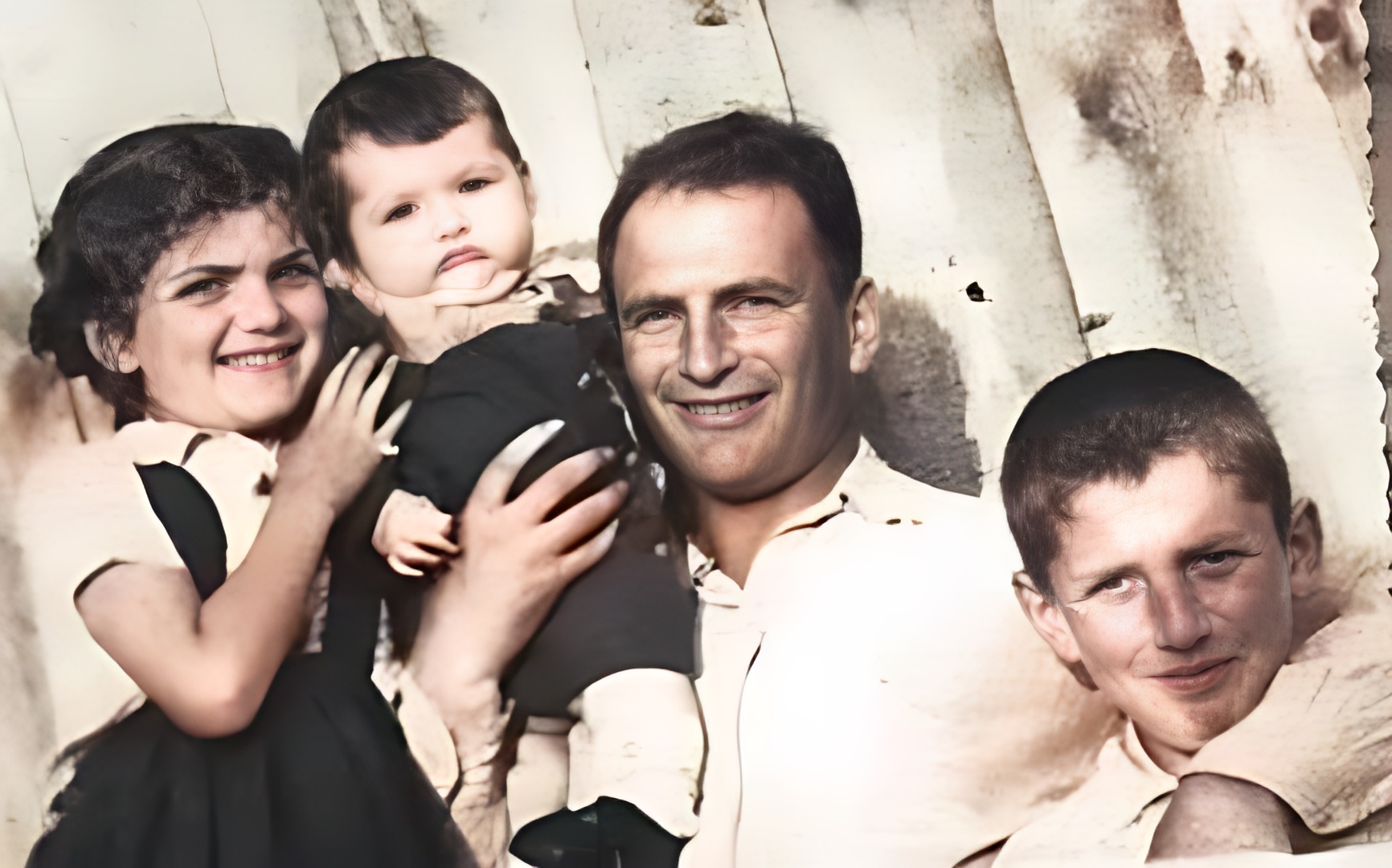
Great-Grandpa David and Great-Grandma Miriam had one son (Yehuda, my grandfather) and three daughters (my aunts—Zina-Zlata, Anya, of blessed memory, and Bella).
Until his last day, despite being gravely ill after many injuries in the army, he sustained his home and family with all his strength, cared for everyone, and above all passed on his legacy of helping your fellow Jews wherever they may be and caring for the vulnerable.
He passed away at the age of 47 after many serious illnesses, but only after ensuring that all his children would receive an education (my grandfather is a doctor, and my aunts are doctors too) and become decent, useful members of society.
He was buried in Russia, and since my grandfather immigrated to Israel and brought his mother and sisters over after him, no member of the family has visited his grave.
Chapter 6: A Personal Interview with His Son, Dr. Yehuda Mendelson (My Grandfather)
Dad brought me into the world, gave me his impressive family name, and taught me almost everything I can do today.
Father, your life was so short, and we had so little time to be true friends. I discovered the understanding side of your soul only two or three years before your death, and the course of my life since then has been a chain of memories and associations with you. You passed away at the age of 49, when I was 27...
Another 27 years later, I buried my mother, who was killed in tragic circumstances on the railway tracks in Atlit, near Haifa.
Dad's life was shrouded in mystery, from his childhood to his military service in World War II, his captivity and miraculous survival- all these subjects were taboo and were not discussed openly.
Dad was born in 1915 in the city of Dvinsk, and his childhood was difficult, with his family wandering from place to place across Europe—Belarus, the Baltic region, Vienna, Minsk... My grandfather Abraham, son of Meir, was an excellent shoemaker, and his wife, Grandma Hannah, was almost completely blind. He spent his youth, during the famine years, in Minsk.
I think his mother tongue was Yiddish, and a Yiddish accent remained in his speech until the end of his life. I remember that after the war, when I was eleven, he wrote out the Yiddish alphabet and taught me to write my name, "Arik," from right to left.
Dad went to work while still a boy. Later, he studied food engineering at a technical college and graduated as a qualified laboratory technician.
He was sent to work in Rechitsa as a young specialist in his field, and there he met a charming young woman - Mara (my mother), and married her.
The army suddenly drafted him and sent him to a signals officers' course in Kazan. His pregnant wife came to visit him, and I was born there. After completing the course, Dad was discharged and we returned to Rechitsa. About three years later, World War II broke out, and Dad volunteered to serve on the front line. I remember him in uniform, with a rifle over his shoulder.
I remember what happened afterward only very vaguely: letters in triangular envelopes arriving from the battlefield, and a small, stained photograph. Later he was declared missing, until one day he was found wounded. Mother traveled to bring him to the military hospital in Kazan. He had endured terrible things during his absence: injuries, three episodes of shell shock, shrapnel wounds to his head, arm, and leg - all before he turned thirty.
But the worst of all happened in the Minsk ghetto, where his entire family perished at the hands of the Nazis, leaving no trace except for him. All his life he searched for any trace of his loved ones, but without success.
Postwar Rechitsa. Our house had been turned into a public toilet by the Germans. Dad renovated it with his own two hands and restored it to its former state. Raising and educating the children, working hard at the large bread bakery, and amid all this he still found time to listen and give advice to anyone who needed it.
The injuries and trauma he suffered during the fighting caused severe liver disease, and despite all the difficulties he managed to provide for his son's and daughter's medical studies. His fierce desire to live never left him until the very last moment, and he had many plans. He came to visit me in Leningrad, and there he died suddenly in my arms. It was May 1, 1964.
A moment before the end, his eyes opened and he looked at me strangely, as though he wanted to say something or reveal some secret. Immediately afterward, his breathing stopped and his soul rose heavenward. It was the most terrible experience of my entire life.
In my book, I try to piece together the fragments of my memories of him.
One can honor one's father even after death, and that is my main purpose.
As for my father's family, it is known that they were not far removed from Judaism. As a child, Dad studied in a "cheder," and his uncle served as rabbi of the town of Vishnevo in Belarus. But, as I have said, they all perished in the Minsk ghetto, and Dad remained the sole surviving branch of that entire destroyed family line.
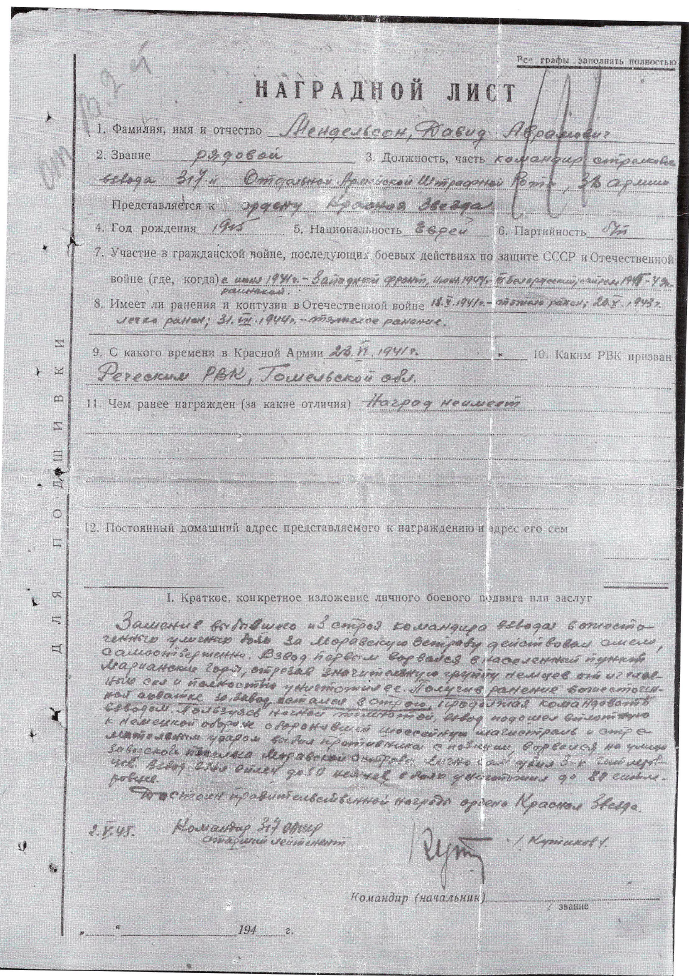
How I Obtained the Above Document:
1. Dr. Albert Kaganovitch, who holds a doctorate in history from the Hebrew University and is currently on assignment in Canada, is writing about the history of the town of Rechitsa and its Jewish heroes.
2. Through a Canadian university, he has access to Soviet archives.
3. There he obtained the above document and emailed it to me (to my father, may he live long and well).
At the Hebrew University, he wrote a book in Russian about the history of the town of Rechitsa.
In that book, he mentioned Grandpa, of blessed memory (David Mendelson).
4. The above document fills in details that were not known when his book was written.
\\\_________________________________________________________________
History:
Grandpa David Mendelson, of blessed memory, once said that he had performed a deed for which he deserved the highest decoration for bravery and distinction in Soviet Russia. However, because of certain circumstances, he did not receive "the Gold," but rather the Red Star.
\\\_________________________________________________________________
A. Since Grandpa was a circumcised Jew who had been captured by the German army and escaped captivity, the Russians did not accept his claim that he had escaped and suspected him of collaborating with the enemy. He was therefore stripped of all his ranks for the first time—he had been a "lieutenant"—and placed in a "cannon fodder" division.
B. Despite everything, he rose through the ranks there too, reaching the rank of "captain." Later, while Grandpa was recovering from his wounds in a hospital in Kazan, he struck an officer who had mistreated him—and once again Grandpa lost all his ranks and decorations and became an ordinary soldier, once more in a "cannon fodder" division.
\\\_________________________________________________________________
The above document is the "Award of a Decoration," the "Red Star," from Grandpa's last period of service in the "cannon fodder" division.
\\\_________________________________________________________________
*Note: An explanation of the term "cannon fodder"— When an army goes to war, those who march at the front are called this. This is because there is no one ahead of them to protect them or check whether the roads are booby-trapped or mined—they are the first to be hit by the enemy. And on top of all this, behind these "cannon fodder" soldiers march soldiers carrying machine guns, and as soon as they approach the enemy - the machine guns begin firing indiscriminately, and these "cannon fodder" soldiers are the first to be hit by that fire, even before the enemy. Danger compounded many times over.
Translation of the Above Document
1. Name: Mendelson, David Abramovich
2. Rank: Ordinary soldier. Private
3. Position: Rifle platoon commander in Company 317, 38th Army (cannon fodder)
Purpose of the document: Award of the Red Star decoration for bravery. (Krasnaya Zvezda).
4. Year of birth: 1915
5. Nationality: Jewish.
6. Party affiliation: Not a party member.
7. Participation in the Civil War and participation in the following (recent) events in defense of the USSR—and World War II.
From June 1941: Western Front.
From June 1944: Third Belorussian Front.
From April 1945: Fourth Ukrainian Front.
8. Wounds sustained in the last war:
18.10.1941 – Seriously wounded.
20.10.1943 – Lightly wounded.
31.7.1944 – Seriously wounded.
9. Date of joining the Red Army – 23.6.1941
10. Place of enlistment: Rechitsa recruiting office, Gomel district.
11. Previous decorations: No decorations.
\\\_________________________________________________________________
Summary of the act of bravery for which the decoration is awarded:
A. Assumed command of the platoon after its commander was killed during extremely fierce street fighting in the Czech region (Moravska Ostrava). Acted with courage and self-sacrifice.
B. The platoon was the first to break into a populated area (Marianske Hory), thereby cutting off a substantial German army force from the main force. It completely destroyed that force.
C. During fierce fighting to capture a factory, he was seriously wounded but continued fighting and commanding the platoon. Later, under cover of darkness, the platoon closed in on the German defensive force guarding the main road and succeeded in defeating that force in a single stroke. They thereby broke into the industrial area of Moravska Ostrava.
D. Personally killed 3 Hitlerites (German soldiers). During the fighting, they took 50 Germans prisoner and destroyed up to 80 Hitlerites (German soldiers), thereby qualifying him for the Red Star decoration for bravery (Order of the Red Star).
2.5.1945 Signed on the document: Commander of Company 317, Lieutenant Kutikov