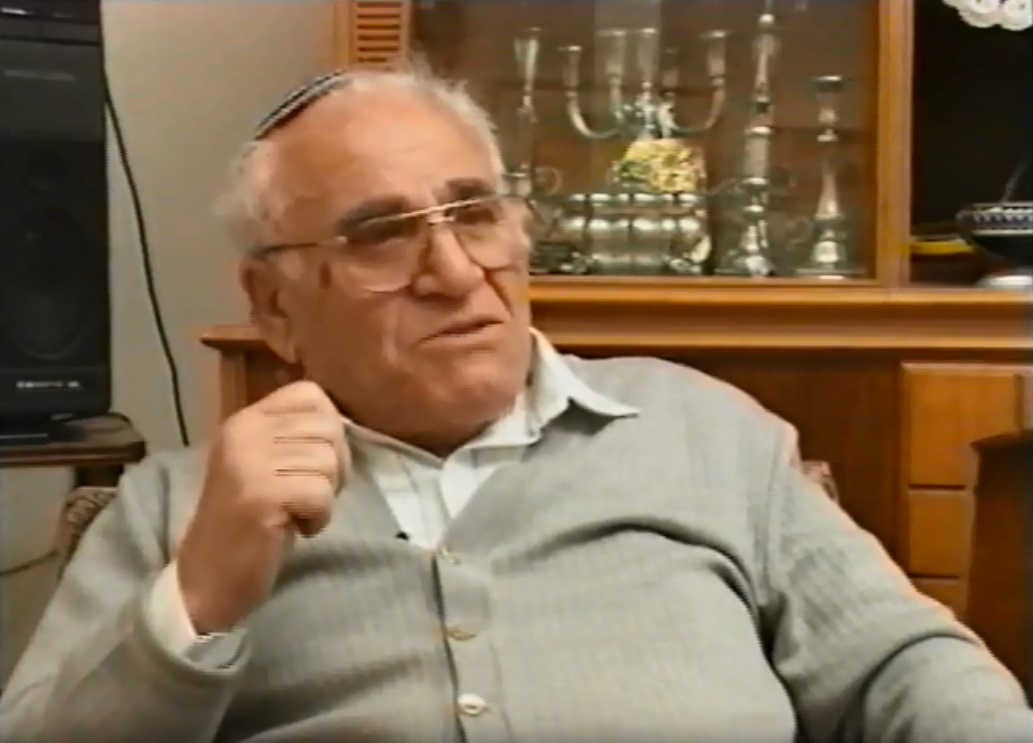
Written by: his grandson, Yoel Spitz
"After five years in labor camps, and after the entire world I knew had been wiped out, including my parents, my brothers and sisters, and my whole family—I found myself alone in Paris. A refugee. Less than human.
I worked in a laundry, and with the little money I saved, I bought myself a motorcycle. I was a young man from a Hasidic family, 24 years old, with no teeth and broken bones all over my body—who had seen what the Holy One, blessed be He, does, and wanted nothing more to do with Him.
Every evening, I would get on my motorcycle and ride like a madman—hoping that sweet death would take me, too. There was something ironic about fighting to stay alive for five years in the camps- only to seek death in Paris.
One day, I went to get a haircut from a friend, a Jew. In the middle of the haircut, a friend of the barber's came in. He was observing a yahrzeit, the anniversary of a loved one's death, and was looking for a minyan. I was far removed from all of that, and pretended not to know what a yahrzeit was, or prayer, or Kaddish.
But the barber knew me. 'Shraga, a yahrzeit! Let's go make up a minyan,' he said. I refused. The barber waved his scissors over my head and, with a laugh, said that if I didn't come, he would stab me.
He pushed, the fellow with the yahrzeit pulled- so I went with them. My condition was that I would not put a kippah on my head. Absolutely not.
We prayed Mincha, said Kaddish, and I wanted to slip away and leave. There were exactly ten of us, and one of the Jews in the synagogue pressed me- 'There's Maariv in another twenty minutes, too. Don't run off on us..'
I felt bad for them and stayed. Between Mincha and Maariv, one of the older Jews in the group taught a passage of Gemara. I knew that passage well.
I had started studying Gemara at age 7, two folios a day, with Rashi and Tosafot. From Bava Metzia onward. In the evening, my father, Alter Yissachar, may God avenge his blood, would come home from work, fill a basin with cold water, wake me, and wash my face and feet to rouse me—then review the passage with me. That was his daily Torah study, and my review of what I had learned at school.
When you learn that way, even five years in the camps cannot make you forget those passages.
But the teacher in that little synagogue in Paris was not my father, nor my rabbi—he was teaching the passage in a completely muddled way. He didn't understand it, so he strained to force all sorts of strange explanations into it.
I sat there without a kippah, pretending not to understand a word. But at a certain point, I couldn't stand it anymore. It was so muddled that I had to say something. I corrected him. Everyone stared at me in astonishment. I had given myself away—they realized I came from a Hasidic family, that I knew my texts, and they- were looking for a teacher, after all.
'If you know the passage so well- you teach it!' they asked. And I, who hadn't opened a Gemara in more than five years, swallowed hard. I wanted to learn and to teach, but I also felt a powerful revulsion toward God and what He had done to me.
'I'm willing to teach, but without a kippah!' I shot back. They - laughed. 'What do we care about a kippah?' they told me. 'We want to learn, and you know how to teach, so go ahead.'
With trembling hands, I held a Gemara again, read in my father's singsong, and explained as my rabbi in cheder had explained. The passage fell into place, every word just where it belonged. And I stayed for Maariv, again without a kippah.
As I was leaving the synagogue, an elderly Jew took my arm. He asked who I was and whom I had studied with. Me? A grandson of Rabbi Eli Singer, head of the rabbinical court of Kalisz. I had studied in the Aleksander Hasidim's cheder in Będzin.
The man looked at me with wide, round eyes. 'I knew your grandfather,' he said. 'I studied Gemara with him on Shabbat. You taught so much like him.. I felt as though we knew each other.' He smiled a kind smile. I burst into tears.
I was deeply moved and asked him to tell me more and more about my grandfather.
And as I walked away, a verse my father had taught me played in my head: "The Eternal One of Israel will neither lie nor change His mind." I understood that if someone still knew my grandfather, and if someone still remembered how he taught, then the world had not been entirely destroyed. Our people were alive - and I, too, could live.
Ever since then, I have carried the knowledge that we have a living people, and a Torah that 'seeks out its old lodgings' and awakens those who once gave it a home to return to it.
And the Holy One, blessed be He? That took another few years. In the end, we made peace.
But every night, in bed, I hold a 'court hearing' with Him: I list my debts and remind myself of His. And I always come out innocent.
There is no doubt- He owes me.
May the soul of Grandpa, and the souls of his entire family, may God avenge their blood, be bound in the bond of life.
In the photos: Grandpa in Paris. His father, Alter Yissachar, may God avenge his blood, after whom I am named (-: