
Holocaust Remembrance Day, 5786.
Confusing days - war, routine, work, holidays. And in between, a day of remembrance. A day of quiet reflection.
The memory is always there.
All my grandparents were Holocaust survivors. Not many of their relatives remained - entire families vanished. In our family, the Holocaust is a living memory; the stories were always part of life, not saved just for Holocaust Remembrance Day.
And part of life, a very significant part, is the fact that all four of my sons are currently serving in the Israel Defense Forces - one in regular service and three in the reserves. It is worrying, stressful, keeps me up at night, and on a day like this it also fills me with pride, gives me strength, and lets me breathe.
Because, as the president said in his speech this evening, my grandparents wore prisoners' uniforms and suffered under a regime of terror, while my children (and my husband) proudly wear IDF uniforms.
My children are singing Hatikvah proudly tonight, with strength for a better future, wearing their uniforms - in Gaza, in the Jordan Valley, in Lebanon, and in the north.
Grandma Rivka used to say that we had defeated the Nazis, and that we were millionaires – because we have families, children, continuity, and we are alive. And that is exactly how it is. My children have grandparents, aunts and uncles, and cousins; it seems so obvious and simple. My parents did not have all that...
So I will leave the hardships and the grumbling for other days.
Today I am holding on to strength, hope, life, and a sigh of relief that we live in our own country, with an army of our own,
And with a heartfelt prayer that remembrance will give us strength, and that we will have the wisdom to preserve what we have and do even more good for ourselves and those around us.
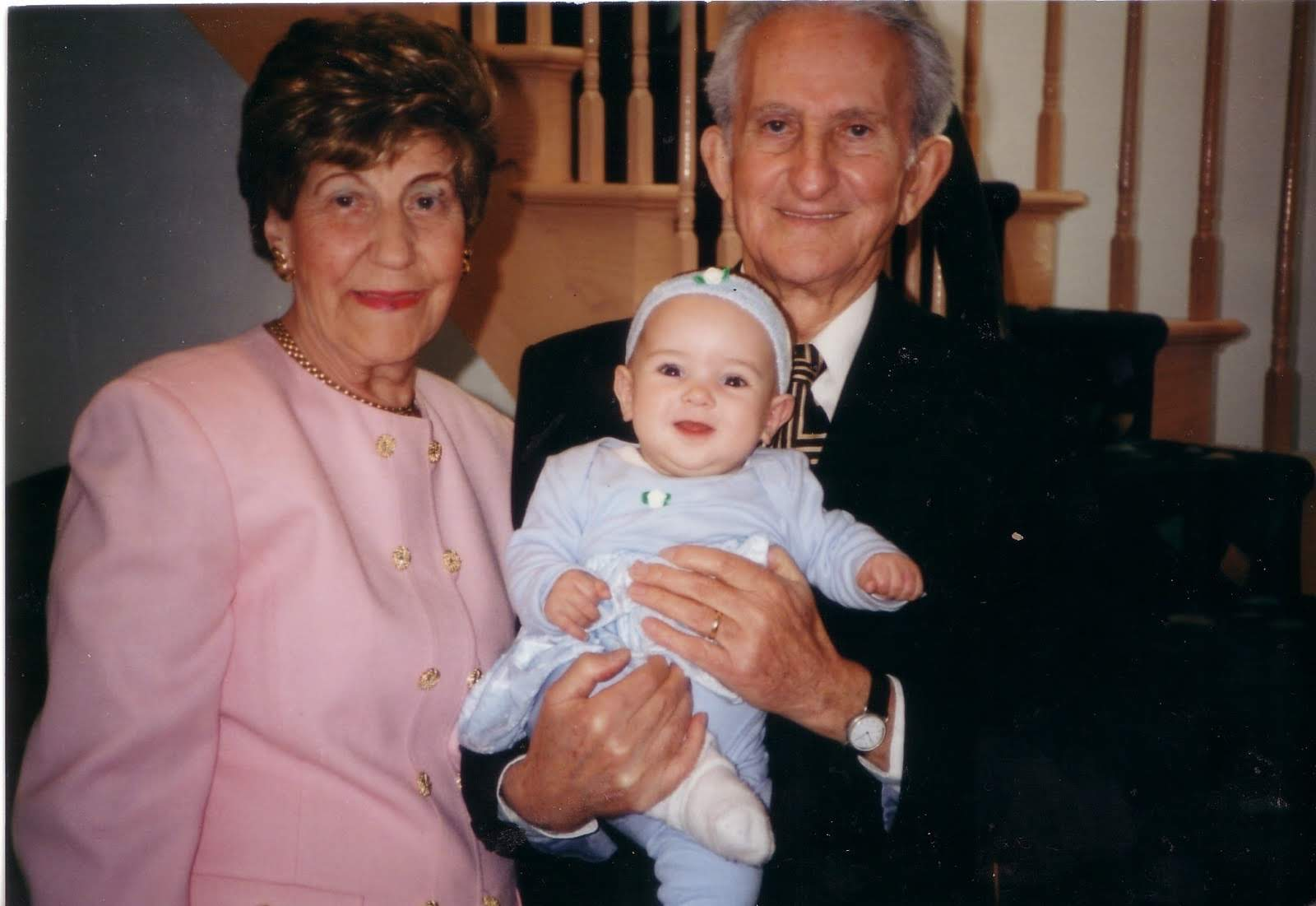
(In the photo, beloved Grandpa David and Grandma Sarah with Avigail, their first great-granddaughter, who would be followed by many more, God willing)
And a photo of the great-granddaughter and the five soldiers
"Zicherman Is Her Name" -
For the elevation of Grandpa David's soul.
*
He has been in Mauthausen for several months now,
Walking like a living corpse.
He does not know what day it is,
Looks at his thin, sick body - and cannot understand whose it is.
Keeps wondering how he ended up here at all.
But when he hears that the group of women awaiting selection at the camp gates today
Has arrived from Hungary -
A spark of life flares within him.
He knows it is dangerous,
But he goes - searching.
Perhaps his sister is there?
He pushes and squeezes through, asking, inquiring.
But no.
She is not there.
Instead, he sees a girl from his town, a few years younger than he is.
And he already knows - there is a good chance she
Will be selected for death.
She does not understand why he is pulling her,
Pushing her to get out of there quickly.
Nor does she understand why he picks up one of the corpses lying around the camp,
And drags it to a hidden corner.
There, off to the side, out of the guards' sight,
He orders her to put on the prisoner's clothes from the corpse.
"Quiet," he says, "so they don't see us."
"And your hair - under the cap! Quick, quick!"
Within minutes she is dressed as a prisoner,
Disguised as a man.
He and his friends make room for her in the barracks.
He protected her until the end of the war.
"She lives nearby,
In New York,"
He tells the interviewer in an everyday voice, though a little emotional.
"Zicherman is her name, her last name, that is."
And I watch him tell the story.
He is proud of what he did, but makes no great fuss about it.
As though it is obvious that he did what needed to be done.
He never spoke of it, only in that interview.
And I, his grandson, have no words.
Only wonder,
Almost endless.
Not only at the courage,
But at the simplicity and clarity
Of a person trapped in hell,
Who cannot even remember who he is,
Yet knows what he must do.
Based on Grandpa David's testimony
On Kaddish and Gemara in Paris / A Story About Grandpa Shraga
*
"After five years in the labor camps,
And after the entire world I knew had been wiped out,
Including my parents, my brothers and sisters, and my whole family-
I found myself alone in Paris. A refugee. Subhuman.
I worked in a laundry, and with the little money I saved, I bought myself a motorcycle.
I was a young man from a Hasidic family, 24 years old, toothless, with broken bones all over my body-
Who had seen what the Holy One, blessed be He, does, and wanted nothing more to do with Him.
Every evening, I would get on the motorcycle and ride like a madman-
Hoping sweet death would take me too.
There was something ironic about having struggled to stay alive for five years in the camps-
Only to seek death in Paris.
One day, I went to get a haircut from a friend, a Jew.
In the middle of the haircut, a friend of the barber's came in.
He was observing a yahrzeit and was looking for a minyan.
I was far removed from all that,
And pretended not to know what a yahrzeit was, or prayer, or Kaddish.
But the barber knew me.
'Shraga, a yahrzeit! Let's go help make up a minyan,' he said.
I refused.
The barber raised his scissors above my head,
And with a laugh said that if I didn't come, he would stab me.
He pushed, the fellow with the yahrzeit pulled-
So I went with them.
My condition was that I would not put a kippah on my head.
Absolutely not.
We prayed Mincha, said Kaddish, and I wanted to slip away and leave.
There were exactly ten of us, and one of the Jews in the synagogue pressed me-
'Maariv is in another twenty minutes, too. Don't run off on us..'
I felt sorry for them and stayed.
Between Mincha and Maariv, one of the older Jews in the group taught a passage of Gemara.
I knew that passage well.
I had begun studying Gemara at the age of 7, two folios a day, with Rashi and Tosafot.
Starting with Bava Metzia.
In the evening, my father, Alter Yissachar, may God avenge his blood,
Would come home from work,
Fill a basin with cold water, wake me,
Wash my face and feet to rouse me-
And then review the passage with me.
That was his daily Torah study, and my review of what I had learned at school.
When you learn like that,
Even five years in the camps cannot make you forget those passages.
But the teacher in that little synagogue in Paris was not my father,
Nor my rabbi -
He was teaching the passage in a completely muddled way.
He did not understand it, and so he strained to offer strange explanations of the passage.
I sat there without a kippah, pretending not to understand a word.
But at some point it drove me crazy,
It was so distorted that I had to say something.
I corrected him.
Everyone looked at me in astonishment. I had given myself away -
They realized I came from a Hasidic family, that I knew my texts, and they- were looking for a teacher, after all.
'If you know the passage so well- you teach it!'
They asked.
And I, who had not opened a Gemara in more than five years, swallowed hard.
I wanted to study and to teach, but I also felt a powerful revulsion toward God and what He had done to me.
'I'm willing to teach, but without a kippah!'
I shot back.
They - laughed.
'What do we care about a kippah?' they told me.
'We want to learn and you know how to teach, so go ahead.'
With trembling hands I held a Gemara again,
Read in my father's singsong, and explained as the rabbi in cheder had explained.
The passage fell into place,
Every word just as it should be.
And I stayed for Maariv, still without a kippah.
As I left the synagogue,
An older Jew took me by the arm.
He asked who I was and who had taught me.
Me?
A grandson of Rabbi Eli Singer, head of the rabbinical court of Kalisz.
I studied in the cheder of the Aleksander Hasidim in Będzin.
The Jew looked at me with wide, round eyes.
'I knew your grandfather,' he said.
'I studied Gemara with him on Shabbat.
You taught so much like him..
I felt as though we knew each other.'
He smiled a kind smile.
I burst into tears.
I was deeply moved and asked him to tell me more and more about my grandfather.
And as I walked away, a verse my father had taught me kept playing in my head:
"The Eternal One of Israel will neither lie nor change His mind."
I realized that if someone still knew my grandfather,
And if someone still remembered how he taught,
Then the world had not been completely destroyed.
Our people lives - and I can live too.
And ever since, I have carried the knowledge that we have a living people,
And we have a Torah that 'seeks out its former lodgings' and awakens them to return to it.
And the Holy One, blessed be He?
That took a few more years. Eventually we made peace.
But every night, in bed, I hold a 'rabbinical court' with Him:
I list my debts and remind Him of His.
And I always come out innocent.
There is no doubt- He owes me."
May the soul of Grandpa, and of his entire family, may God avenge their blood, be bound in the bond of life.
The General Day of Kaddish.
So today, during the morning prayers, I thought about my father's father, Grandpa David, of blessed memory.
Grandpa was born in 1918 in Beregszász, Hungary.
His parents - Eliezer and Tzipora Spitz
His siblings - Eva, Bela, Marton, Shmuel, Betty, Miriam
- Were murdered by the Nazis on an unknown date.
We do not even know the names of the spouses of his siblings, some of whom were married, or how many children they had.
On October 5, 1939, Grandpa was conscripted into the Hungarian army for forced labor.
Because he was Jewish, they did not give him a weapon, and put him to work at a deadly task - digging frontline trenches for Hungarian soldiers - on the Russian front.
In the early 1940s, Grandpa was taken prisoner by the Russians, and in 1942 he was captured by the Nazis.
Together with other Jews who had endured a similar journey, he was put to work in horrific labor camps whose names we do not know, imprisoned for a long time in Mauthausen, and from there sent on the terrible death march.
On the death march, Grandpa met his brother Binyamin - for the first time in about five years.
They marched together for several weeks, and on the morning of April 26, 1945, about two weeks before the end of the war, Binyamin was shot dead on a Nazi soldier's whim.
After the march, Grandpa was liberated by the Russian army.
Eight friends from Hungary accompanied Grandpa through large parts of his journey, and all of them were killed.
In the video at the attached link (in the first comment), he lists their names and tells their stories.
I thought of him this morning because, throughout all his horrific journeys, he held on to his tefillin.
As far as I know, the only object he had with him throughout the war (and which is still with us!) was his tefillin - a photo of which is attached to this post.
So last night I spread out the parchment passages from his head tefillin (the only ones we have) on the table at home, and today I thought about what this means to me and what message should go from here straight to the Holy One, blessed be He.
And I thought of these two verses:
All this has come upon us, yet we have not forgotten You, nor have we been false to Your covenant. (Psalms 44:18)
And despite all this, we have not forgotten Your name. Please do not forget us. (From the Selichot prayers)
The story of the tefillin is told in Grandpa's modest, compressed way at minute 25 of the video attached in the first comment (for anyone interested - there are subtitles)
Home / Something About Grandpa
A.
Grandpa longed intensely for what had been 'there,'
For the world before the war,
Before the Holocaust.
I knew this because I spent so much time with him.
Almost every day,
After kindergarten or school, I would go to his house,
To get a sweet and hear stories.
"Grandpa, tell me stories about the Holocaust," I would ask.
I loved his stories. They were hard, and perhaps not appropriate for my age, but I loved the resourcefulness Grandpa showed in them,
How he escaped, how he outwitted some Nazi, or how he was saved from death at the last moment.
When I asked for a story about the Holocaust, Grandpa would sit me down on the sofa and say:
"I'll tell you,
But to understand what happened in the Holocaust,
You have to understand what came before it and what our lives were like there."
And so I would sit and listen,
To stories about his aunts,
About his little brother Avraham, with his dark skin ("Just like you," Grandpa would add),
About the great synagogue of Będzin,
And about the Aleksander Hasidim's prayer house in Grandpa's grandfather's courtyard.
When Grandpa described Będzin,
He would be drawn right in.
The melodies would soon follow, and he would begin to sing.
Melodies he had heard from his mother, who had heard them from hers,
Then came the recipes, how they made jam, and how they spread goose fat on bread.
Really, once he started talking about it, there was no stopping him.
I was only a young child,
But I needed no explanation,
I understood on my own-
That Grandpa was homesick.
He might be old and brave and resourceful,
But he was still a little bit of a child-
Whose mother and father had been taken away.
And his home.
B.
Grandpa's longing for the world that had been found a surreal and somewhat extreme expression in the matter of eating gefilte fish.
It mattered to Grandpa that I eat gefilte fish,
It mattered very much.
Shabbat after Shabbat, he would drive me crazy insisting that I eat those gray patties with the orange carrot and fish stock.
But to me, an Israeli boy from Samaria- it was simply disgusting.
I had no problem cutting up the carp with him, grinding it, shaping the patties,
But eating it - absolutely not!
Yet Grandpa insisted.
Today I can say that his insistence was strange, and perhaps came from his shattered world,
But that was how it was.
One Shabbat,
My parents went away for some celebration, and my brother, my sisters, and I went to eat at Grandpa's.
And once again the gefilte fish scene repeated itself; this time even more intensely..
That Shabbat,
After I had refused once and then twice to eat, Grandpa looked at me in disappointment and said:
"Fine, don't eat it.
But you should know that if you don't, you won't have a Jewish brain.
You won't be able to study Gemara,
Or play chess!"
For me, a child in second or third grade, that was the worst thing I could possibly hear from him.
In the few seconds I had to think,
I must have imagined myself as some sort of half-Jew who did not know how to open the great Gemara- as my grandfather did,
And could not even play a decent game of chess at night.
Well,
I ate the gefilte fish.
With salty tears, I ate the gefilte fish.
To this day, I remember the taste of the fish mingled with my tears.
(And actually, I found it delicious, so to this day I am hooked on that gray patty)
And what about getting that Jewish brain, you ask?
Well, after that Shabbat meal, I went for a walk with Grandpa around the community.
It was Shabbat Shirah, and in my innocent excitement over the new brain I had acquired -
I shared wonderful new insights into the Song of the Sea with him.
The insights grew out of one another and intertwined, as only a fresh, brand-new Jewish brain could invent.
And Grandpa?
He was very happy on that walk, and with those words of Torah.
From the distance of all these years, I think that is what someone looks like when they have returned,
Even for a moment- home.
The Battle of Ai and Strategic Deterrence
A New National Vision for Human Capital in the Education System
Believing Again: In-Depth Answers to Questions of Faith You Have Never Had Answered Daniel Cohen Proofreading – Yakir Kossman To book lectures and classes and to obtain the book, call- 0524055170 Insights and comments, questions of faith, at the number above or by email- danicohe