It all started with a few questions that bothered me over the years as I read the Torah portions about the Exodus from Egypt:
A. Why does Moses ask Pharaoh to let the Israelites go worship God in the wilderness for a day (three days' journey away), rather than to free them from Egypt?
18 They will listen to you, and you and the elders of Israel shall come to the king of Egypt and say to him: The LORD, the God of the Hebrews, has appeared to us. Now please let us go three days' journey into the wilderness and sacrifice to the LORD our God. (Chapter 3)
22 You shall say to Pharaoh: Thus says the LORD: Israel is My firstborn son. 23 I said to you, Let My son go, so that he may worship Me, but you refused to let him go. Behold, I will kill your firstborn son. (Chapter 4)
1 Afterward Moses and Aaron came and said to Pharaoh: Thus says the LORD, the God of Israel: Let My people go, so that they may hold a festival for Me in the wilderness. 2 Pharaoh said: Who is the LORD, that I should obey Him and let Israel go? I do not know the LORD, nor will I let Israel go. 3 They said: The God of the Hebrews has appeared to us. Please let us go three days' journey into the wilderness and sacrifice to the LORD our God, lest He strike us with pestilence or the sword. (Chapter 5)
26 The LORD said to Moses: Go to Pharaoh and say to him: Thus says the LORD: Let My people go, so that they may worship Me. (Chapter 7)
16 The LORD said to Moses: Rise early in the morning and stand before Pharaoh as he goes out to the water, and say to him: Thus says the LORD: Let My people go, so that they may worship Me.
21 Pharaoh summoned Moses and Aaron and said: Go, sacrifice to your God within the land. 22 Moses said: It would not be right to do so, for what we sacrifice to the LORD our God is an abomination to the Egyptians. If we sacrifice what is an abomination to the Egyptians before their very eyes, will they not stone us? 23 We will go three days' journey into the wilderness and sacrifice to the LORD our God, as He commands us. 24 Pharaoh said: I will let you go and sacrifice to the LORD your God in the wilderness, but you must not go very far away. Pray for me. 25 Moses said: I am now leaving you, and I will pray to the LORD, and tomorrow the swarms will depart from Pharaoh, his servants, and his people. Only let Pharaoh not act deceitfully again by refusing to let the people go sacrifice to the LORD (Chapter 8)
1 The LORD said to Moses: Go to Pharaoh and tell him: Thus says the LORD, the God of the Hebrews: Let My people go, so that they may worship Me.( Chapter 9)
3 Moses and Aaron came to Pharaoh and said to him: Thus says the LORD, the God of the Hebrews: How long will you refuse to humble yourself before Me? Let My people go, so that they may worship Me... 7 Pharaoh's servants said to him: How long will this man be a snare to us? Let the men go, so that they may worship the LORD their God. Do you not yet realize that Egypt is ruined? 8 Moses and Aaron were brought back to Pharaoh, and he said to them: Go, worship the LORD your God. Who exactly will be going? 9 Moses said: We will go with our young and our old; we will go with our sons and daughters, our flocks and herds, for we have a festival to the LORD. 10 He said to them: May the LORD be with you as surely as I will let you and your children go! Beware, for evil lies ahead of you. 11 Not so! Let the men go and worship the LORD, for that is what you are asking for. And they were driven out of Pharaoh's presence... 24 Pharaoh summoned Moses and said: Go, worship the LORD. Only your flocks and herds must remain behind; your children may go with you too. 25 Moses said: You yourself must also provide us with sacrifices and burnt offerings, so that we may offer them to the LORD our God. 26 Our livestock must also go with us; not a hoof shall remain behind, for we must take from it to worship the LORD our God, and we will not know what we need to worship the LORD until we arrive there. (Chapter 10)
31 He summoned Moses and Aaron by night and said: Get up, leave my people, both you and the Israelites, and go worship the LORD, as you have said. 32 Take your flocks and herds too, as you have said, and go, and bless me too. (Chapter 12)
B. Why does the Boss ask Israel to lie to the Egyptians about taking their silver and gold objects?
21 I will grant this people favor in the eyes of the Egyptians, so that when you leave, you will not leave empty-handed. 22 Each woman shall ask her neighbor and the woman living in her house for silver objects, gold objects, and clothing. You shall put them on your sons and daughters, and so you shall strip Egypt. (Chapter 3)
1 The LORD said to Moses: I will bring one more plague upon Pharaoh and Egypt; after that he will let you go from here. When he lets you go, he will drive you out of here altogether. 2 Please tell the people that each man should ask his neighbor, and each woman her neighbor, for silver and gold objects. (Chapter 11)
C. How is it that Pharaoh, with the Egyptian Mossad and Shin Bet, does not know what three million Jews know: that the Jews are not actually going to worship God three days' journey away, but are leaving Egypt and not coming back? He only discovers this after six days have passed and they have not returned...
. 5 The king of Egypt was told that the people had fled, and Pharaoh and his servants had a change of heart toward the people. They said: What have we done, letting Israel go from serving us? (Chapter 14)
This is especially puzzling because it seems that the Jews lived among the Egyptians, as we see in the command:
21 I will grant this people favor in the eyes of the Egyptians, so that when you leave, you will not leave empty-handed. 22 Each woman shall ask her neighbor and the woman living in her house for silver objects, gold objects, and clothing. You shall put them on your sons and daughters, and so you shall strip Egypt. (Chapter 3)
D. Why, during the Exodus from Egypt, amid all the logistical chaos of getting millions of people on the road, does Moses go off to deal with Joseph's bones, when there are hundreds of thousands of members of the tribes of Ephraim and Manasseh who could handle it and fulfill the oath?
19 Moses took Joseph's bones with him, for Joseph had made the Israelites swear an oath, saying: God will surely remember you, and you shall bring my bones up from here with you
E. Why do the Israelites want to return to Egypt at every moment of crisis?
F. How is it that the mixed multitude, who were converts wanting to join the people of Israel, cause such turmoil in the wilderness? Aren't converts usually much more serious than ordinary Jews?
G. Why don't the Israelites take enough food and water with them for a long stay in the wilderness?
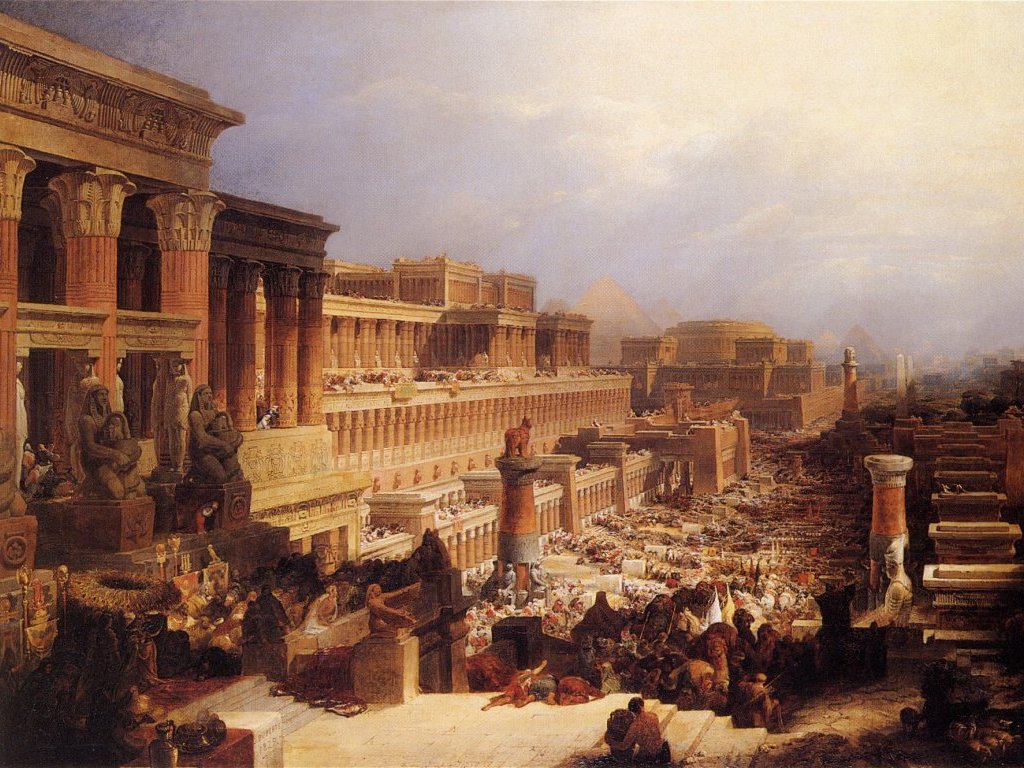
(Image from Wikipedia)
Well, the answer is very simple:
The Israelites simply did not know that they were leaving Egypt and not coming back!!!! Like Pharaoh, they were sure they were going to worship God in the wilderness and then return to Egypt!
In other words, the Israelites knew that there was a long process (the Exodus story itself took six months) at the end of which they would be redeemed (as promised in the Covenant Between the Pieces), but they did not know that on Passover night they were actually being redeemed.
The Israelites first discover this at the splitting of the Red Sea:
13 Moses said to the people: Do not be afraid. Stand firm and see the deliverance the LORD will bring you today, for the Egyptians you have seen today, you will never see again
This makes the following clear:
A. The discussion with Pharaoh was not a national, political discussion about freeing slaves, but a discussion of faith (theology) about God's existence and influence in the world (. 2 Pharaoh said: Who is the LORD, that I should obey Him and let Israel go? I do not know the LORD, nor will I let Israel go)
B. The Israelites were certain that they were indeed borrowing objects from the Egyptians and would return them upon coming back from the wilderness, because they did not know they would not be returning. It is also possible that this was actually an exchange for all the possessions and real estate the Israelites left behind in Egypt. That is why they borrowed the objects for worship specifically from their neighbors.
C. Egyptian intelligence did not uncover the plot because no one apart from Moses and Aaron (and perhaps the elders of Israel) knew about it. The compartmentalization was perfect!
D. Moses had to take Joseph's bones because no one else knew, or could be allowed to know, that they were not actually returning to Egypt.
E. The Israelites wanted to return to Egypt because they were not psychologically prepared for the Exodus from Egypt
F. The mixed multitude who joined in worshipping God in the wilderness never imagined that they would not return to Egypt
Why weren't the Israelites told that they were leaving Egypt?
A. The whole discussion is about faith (theology), about God's existence in the world and His rule over all the different forces of nature (as revealed through the plagues, the defeat of all the gods of Egypt (the Nile, the sheep, Pharaoh, and the firstborn). Its purpose is to reveal God's existence in the world. In other words, Seder night is not a celebration of redemption but a celebration of faith. In the Kuzari, Rabbi Judah Halevi explains that the Exodus from Egypt was a departure from the Boss's rules of operation (hidden providence, which allows people the free choice not to believe): that is, open miracles that are the foundation of faith in the Boss and His Torah. Testimony to this departure is what we pass down from generation to generation, from then until today, on Seder night.
B. The Israelites could not grasp the implications of such a dramatic move (see Ramban below)
C. It is very hard for an entire people to leave its homeland after 210 years of exile. We see this too in the redemption following the First Temple era: when the Israelites receive permission from Cyrus to return to the land 70 years after being exiled, only a tiny few actually return to Israel. Most remain in Babylon. We can also look at American Jewry, most of whom arrived after the Holocaust: it is really very hard to get them to move to Israel.
D. The Israelites are leaving behind a great deal of property: houses, fields, cars, televisions. Had they known, it would have taken them a long time to prepare to leave, if they left at all.
E. The Egyptians, too, would have been unable to digest such a demand (look at the civil war that broke out 200 years ago when people wanted to free the slaves in the United States). So, to keep the entire discussion (and thus the punishment) within the realm of their free choice, only the demand to worship was presented.
I was asked whether I had seen any evidence for this.
Well, this would seem to be the plain meaning of the verses; nothing else is written.
Later, my friend Rabbi Tzvika Hershkovitz showed me that this is also written in Ramban's commentary on the verse:
12 He said: I will be with you, and this shall be the sign for you that I have sent you: when you bring the people out of Egypt, you shall worship God on this mountain (Chapter 3)
There are many interpretations of this verse, but the correct one according to its plain meaning is that the Holy One, blessed be He, told Moses two things: that He had come down to rescue them from the Egyptians—and He could have rescued them from their hands within the land of Goshen itself or nearby—but He further promised to bring them up out of that entire land to the place of the Canaanites (above, verse 8). Moses was afraid of both things, and said: Who am I that I should go to Pharaoh? I am a lowly man, a shepherd, while he is a great king, and if I tell him to release the entire people, he will kill me, as Samuel said: If Saul hears, he will kill me ( I Samuel 16:2). He also said: Who am I that I should bring the Israelites out of the land of Egypt, as You told me, to bring them up to the land of Canaan? For this great nation is a wise and discerning people, and they will not think enough of me to follow me to a land of nations greater and mightier than themselves, as You said, to bring them up to a good and spacious land, to the place of the Canaanites. For rescue from Pharaoh does not depend on them: if Pharaoh listens, he will lighten his yoke upon them and deliver them, or drive them out of his land against their will. Moreover, they themselves would listen to anyone on this matter, for who would not wish to escape such unparalleled hard labor? But as for going up to the land of the Canaanites, they will not listen. And so it was: war against those nations was difficult for them from beginning to end, and they feared it in Egypt and in the wilderness. This was Moses our teacher's fear of Pharaoh and his apprehension about them. God answered him on both points. He told him: Do not fear Pharaoh, for I will be with you to rescue you. And this shall be the sign for you to the people that I have sent you to them: when you bring the people out of Egypt, you shall worship God on this mountain. From then on they will accept the service of God, following His commands, and they will also believe in you forever (below, 19:9), and will follow you eagerly wherever you command them. Behold, I have appeared to you on this mountain in a flame of fire, for so it shall be in the eyes of all the people when they worship Me on this mountain. Thus Moses had a sign that he need not fear Pharaoh, since God had promised to rescue him; and Israel would have a sign that they need not fear the nations when they came to Mount Sinai. For they would certainly agree to leave Egypt with Pharaoh's consent for a nearby place, a three-day journey away, to sacrifice to God, and they would do so, whether willingly or unwillingly. And according to the mystical interpretation, “this shall be the sign for you” is like “these twenty years of mine” ( Genesis 31:41). He said: I will be with you, and here is the sign for you, the sign of the covenant, that I will always be with you, as in “As for Me, behold, My covenant is with you” (ibid. 17:4), for it is I who send you so that you may worship God on this mountain, and then I too will go up in the midst of this people to the place I have prepared (below, 23:20(
Further objections to the idea:
Objection A: In the passage “Consecrate to Me every firstborn” (which is written before the Exodus from Egypt), it explicitly says:
1 The LORD spoke to Moses, saying: 2 Consecrate to Me every firstborn, the first offspring of every womb among the Israelites, both human and animal; it is Mine. 3 Moses said to the people: Remember this day, on which you came out of Egypt, out of the house of slavery, for with a mighty hand the LORD brought you out of here, and no leavened bread shall be eaten. 4 Today you are leaving, in the month of spring. 5 When the LORD brings you into the land of the Canaanites, Hittites, Amorites, Hivites, and Jebusites, which He swore to your ancestors to give you, a land flowing with milk and honey, you shall observe this service in this month. (Chapter 13)
I heard the answer to this question from Rabbi Yisrael Shachor, may he live long, who explains that this passage, like other passages in the Torah (the passages on circumcision, the sciatic nerve, firstborns, and others), is actually a later addition, given after the giving of the Torah and inserted here. As the Talmud says regarding the sciatic nerve in Chullin, page 100 (thanks to Rabbi Yedidya Kahana for the source):
“Mishnah: It applies to clean animals and does not apply to unclean animals. Rabbi Judah says: It applies to unclean animals as well. Rabbi Judah said: Wasn't the sciatic nerve prohibited from the time of Jacob's sons, when unclean animals were still permitted to them? (After all, the passage about the sciatic nerve is written during Jacob's return to Israel after his struggle with the angel, long before the giving of the Torah. A.M.) They said to him: It was stated at Sinai, but written in its proper place.” In other words, this section was stated after the giving of the Torah, but was inserted in the relevant location when the Torah was arranged.
Objection B: The Israelites are told in several places that they will leave Egypt. However, in none of these places is it clearly stated when and how they will leave Egypt; rather, these are general statements about redemption (like a class on Rabbi Kook's “Orot”):
First, note that some of these things were said only to Moses, and those are not quoted below.
16 Go and gather the elders of Israel and say to them: The LORD, the God of your ancestors, the God of Abraham, Isaac, and Jacob, has appeared to me, saying: I have surely remembered you and what has been done to you in Egypt. 17 And I have said: I will bring you up out of the affliction of Egypt to the land of the Canaanites, Hittites, Amorites, Perizzites, Hivites, and Jebusites, to a land flowing with milk and honey. 18 They will listen to you, and you and the elders of Israel shall come to the king of Egypt and say to him: The LORD, the God of the Hebrews, has appeared to us. Now please let us go three days' journey into the wilderness and sacrifice to the LORD our God. (Chapter 3)
29 Moses and Aaron went and gathered all the elders of the Israelites. 30 Aaron spoke all the words that the LORD had spoken to Moses, and performed the signs before the people's eyes. 31 The people believed, and when they heard that the LORD had remembered the Israelites and had seen their affliction, they bowed down and worshipped. (Chapter 4)
6 Therefore say to the Israelites: I am the LORD, and I will bring you out from under the burdens of Egypt, rescue you from their slavery, and redeem you with an outstretched arm and mighty judgments. 7 I will take you as My people, and I will be your God, and you shall know that I am the LORD your God, who brings you out from under the burdens of Egypt. 8 I will bring you into the land that I swore to give to Abraham, Isaac, and Jacob, and I will give it to you as a possession. I am the LORD. 9 Moses spoke thus to the Israelites, but they did not listen to Moses because of their broken spirit and hard labor. (Chapter 6)
17 You shall observe the Festival of Unleavened Bread, for on this very day I brought your hosts out of the land of Egypt. You shall observe this day throughout your generations as an everlasting ordinance. 18 In the first month, from the evening of the fourteenth day of the month until the evening of the twenty-first day of the month, you shall eat unleavened bread. 19 For seven days no leaven shall be found in your houses, for whoever eats anything leavened shall be cut off from the congregation of Israel, whether a stranger or a native of the land. 20 You shall eat nothing leavened; in all your dwellings you shall eat unleavened bread. (Chapter 12) – It does not say that they are leaving for Israel; see Rabbi Shachor's answer above
I'd be happy to hear your questions and comments:
Avi Mendelson
054-2201174